
Personal Health Ledger
Personal Health Ledger keeps a private timeline of feelings, measurements, events, administrations, safety notes, and plan changes. It can help prepare a clinician-ready summary while keeping observations separate from medical conclusions.
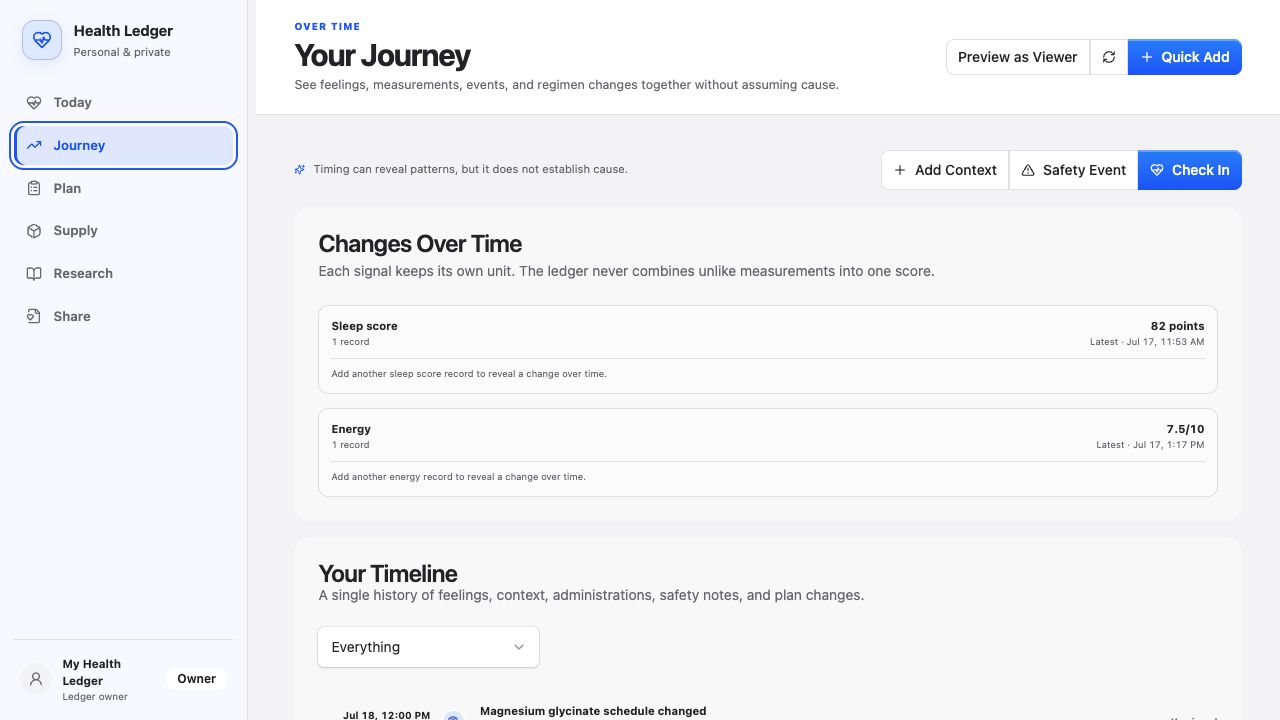
Why It Was Made
Sensitive personal data needs a clearer boundary than a generic CRUD sample. This example uses user-scoped storage, explicit research origins, specialist authority, a bounded MCP drafting tool, and VFS export while refusing to turn timing or model output into a diagnosis.
Surface Map
The code uses sdk.authorization, sdk.channels, sdk.http, sdk.specialist, sdk.storage, and sdk.vfs. The permission catalog separates view, manage, research, export, network, channel, specialist, and VFS authority.
Design Boundaries to Notice
- The MCP tool can draft structured administration data, but the desktop surface revalidates it and requires confirmation before changing the ledger.
- Research uses an explicit allowlist of public evidence sources.
- Export is a separate authority from viewing or managing the private ledger.
- Specialist output records source and tool receipts so a later reader can distinguish evidence from generated interpretation.
What to Read in the Code
- Package descriptor for user scope, research effects, specialist, MCP, and permissions.
- Research sources for bounded external origins.
- Specialist integration for evidence-linked research turns.
- Administration MCP tool for the non-committing draft boundary.
Run It Locally
Link apps/personal-health-ledger/.tap-package once. The desktop and QuickJS targets refresh through one watched package graph. Research and export still require their declared host authority.
Browse the source or return to the example gallery.